
Toledo City Directory Collections
The first stop is the Toledo-Lucas County Public Library Local History and Genealogy Department at Main Library. It holds the documented Toledo runs, local-government microfilm, newspapers, yearbooks, maps, manuscript inventories, and genealogy material. A screen copy is useful, but the third-floor department is the fuller access route when an item is restricted, undigitized, or hard to interpret. The desk accepts one-to-one appointments and answers questions at 419-259-5233.
| Collection | Years | Where Held | Access |
|---|---|---|---|
| Toledo City Directories | 1858-present | TLCPL Local History | 1858-1935 on microfilm; 1936-present in books |
| Toledo Suburban Directories | 1957-present | TLCPL Local History | Consult the local collection for nearby Lucas County places |
| Hubbell's Blue Books | 1888-1910 | Ohio Memory and TLCPL guide | Name, address, school, and club-reference companion where available |
| Blade Obituary Index | 1837-present | TLCPL genealogy resources | Online index with a copy-request route |
For the main run, the Library distinguishes format rather than inventing one continuous online shelf. Exact digital runs must be checked in the TLCPL Digital Collections; staff and the physical collection fill the gaps. The catalog labels one Polk set 1858-1986 while the current inventory says 1858-present, so a final publishing year should not be inferred from those two descriptions.
The format break creates a useful Toledo-specific search choice. A researcher looking for a year from 1858 through 1935 should expect microfilm at Local History, while a later run is held in books. The documented street/address index begins in 1910, so a pre-1910 address search may need the surname, business name, map, plat, or cross-street wording that the volume printed. Record the exact year and format before drawing any conclusion from an absent or partial entry.
Toledo City Directory Access at Local History
The Local History books inventory is the clearest starting point for locating the Toledo volumes. It identifies the main city directories, suburban directories, and related research material. Main Library's third-floor department is also the fallback for items that do not yield a clear result online. Calling 419-259-5233 before a focused visit is sensible when the search needs microfilm, a map, a Block Card, an obituary copy, or help reading an old address.
The Library's directory holdings show the local shelf that supports that work.
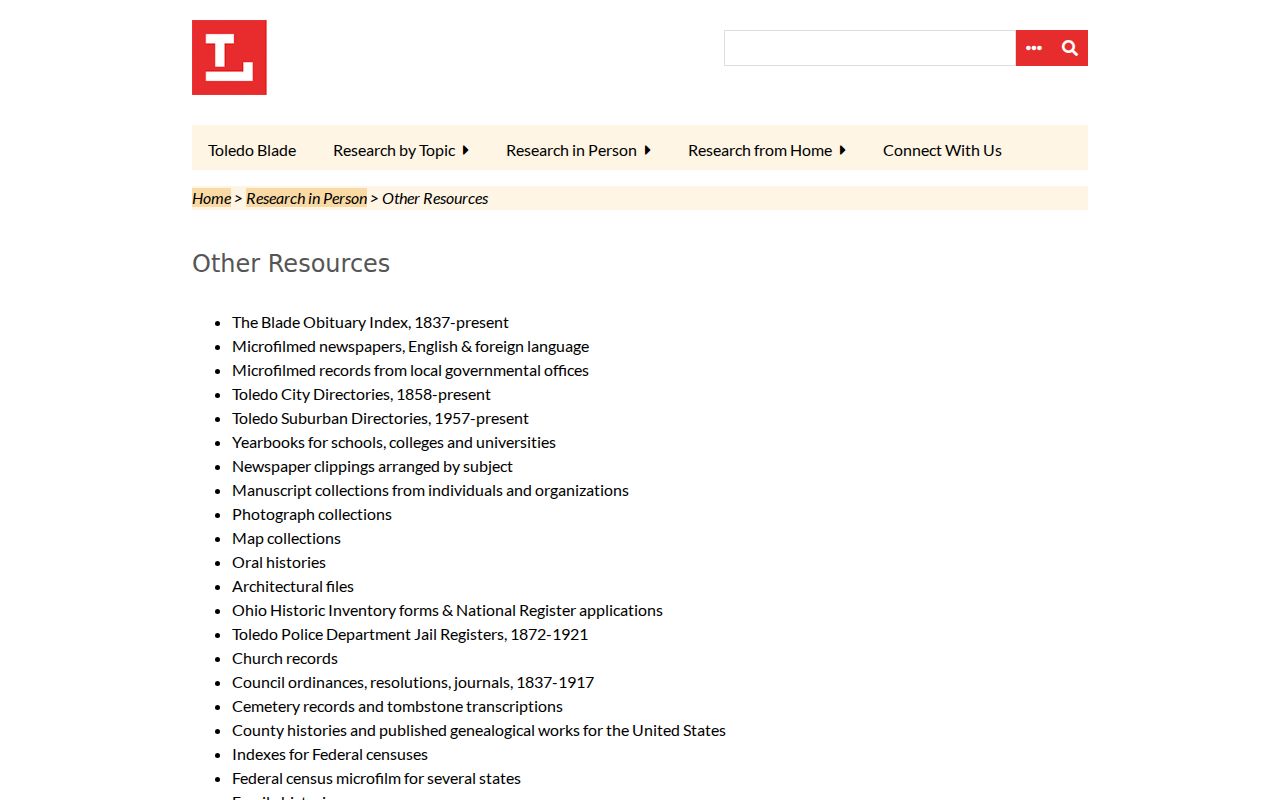
The holdings view is a useful reminder to record the volume year and format before taking notes. A microfilm reel, a bound book, and a digitized item can represent different access paths to the same subject.
Read Each Toledo City Directory Entry
The inspected 1860 item makes a city directory more than a list of names. A printed entry can carry a surname, given name or initials, trade, firm relationship, residence or boarding notation, and a street location. It may also point to a hotel or boarding house, or sit beside a firm advertisement. Record exactly what is printed, including the page and volume. Do not turn a historical trade line into proof of a present-day connection.
| Name | Surname plus the printed given name or initials. |
|---|---|
| Trade or relationship | Only the trade, firm relationship, or other detail actually printed in that volume. |
| Residence wording | A numbered street where present, or a side-of-street and cross-street form in early entries. |
| Boarding or hotel note | A printed lodging reference, not a conclusion about ownership. |
| Volume reference | The named year and page needed to return to the source. |
Directory abbreviations are not a fixed Toledo codebook. The 1860 Ohio Memory directory record shows forms such as bds, res, and h, but each volume's own front matter must be checked before an abbreviation is expanded.
- Street index
- The address route within a directory. Toledo's documented street/address index begins in 1910.
- Entry transcription
- A copy of the words and abbreviations as printed, with the volume and page retained.
- Abbreviation key
- The explanatory list in the particular volume, used before turning initials or shorthand into a full statement.
- Directory cycle
- One publication's snapshot, not the same date or method as a federal census.
Early Toledo City Directory Addresses
Toledo's first verified directory appeared in 1858. In the early years, incomplete house numbering meant editors sometimes placed a person by block and cross streets instead of a modern-style number. That is why an address search before the street index began in 1910 may need a surname, business name, plat, or map alongside the directory. A surface match with a modern street number is not enough.
The digitized 1860 Polk's Toledo City Directory is a 266-page item preserved by TLCPL and digitized in 2017. Its record has full-text/OCR search, page navigation, and descriptive metadata, useful tools for checking a lead against the printed page.
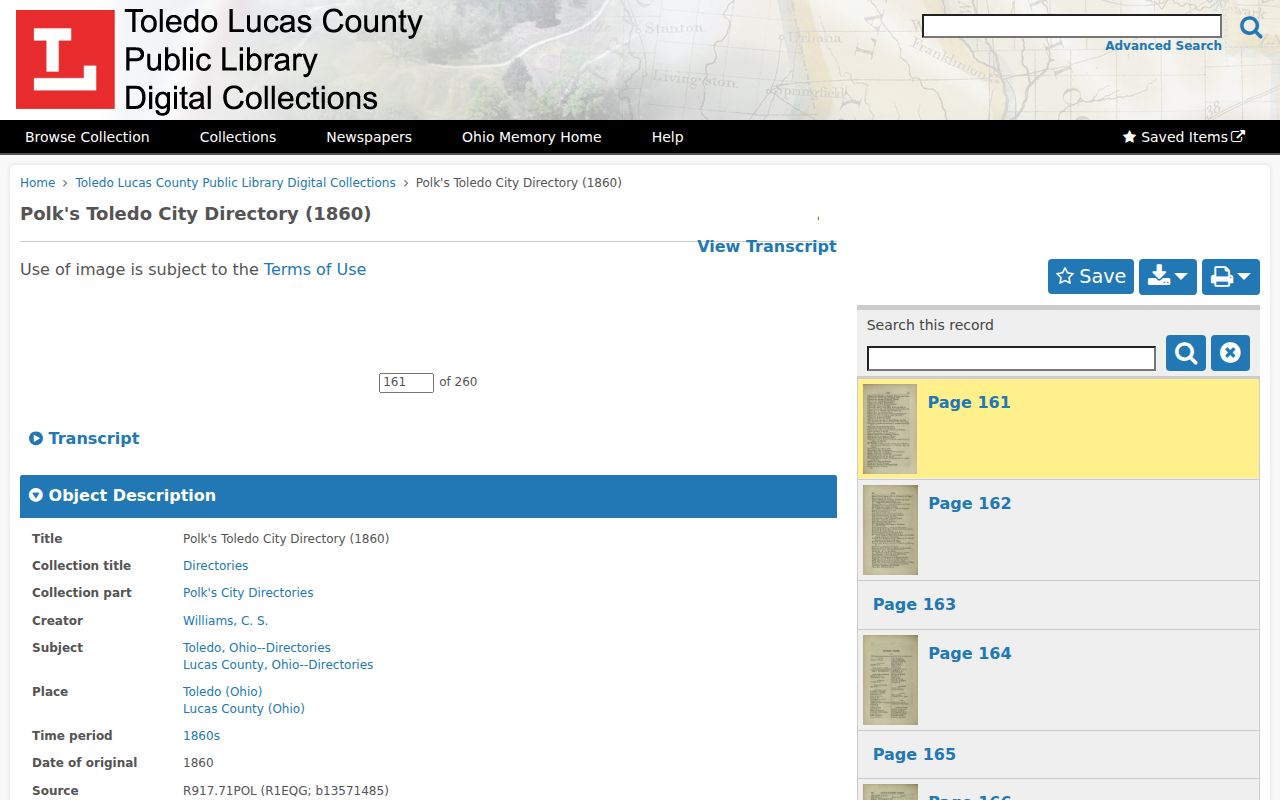
The digitized example shows why the printed location phrase matters. A cross-street description can be the strongest address evidence in an early entry, even when it cannot be read as a current house number.
Trace Toledo City Directory Years
A household trail works best when each source keeps its own date. The directory identifies a published year, while a released federal census is a separate enumeration. TLCPL's licensed HeritageQuest access identifies federal census coverage from 1790 through 1940, and its other onsite resources provide additional research channels. A directory result can therefore be checked against a nearby census without pretending both records describe the same day.
- Choose a directory year and transcribe the name, printed address, page, and any wording that identifies the household.
- Check an adjacent directory volume for the same surname and address. A disappearance can mean a move, death, or omission, so it needs another source.
- Pair the relevant period with a released census through TLCPL research access, keeping the census date separate from the directory year.
- Use the Blade Obituary Index or a requested copy when an end point is needed for a person already identified in the historical sources.
From 1910 forward, the directory's street index adds an address route. Before that, the name-first method and map evidence carry more weight. For a full backward address trail, the Toledo past-residents record trail connects a parcel's legal description to the Recorder's older index eras.
Toledo City Directory Map Companions
Directories tell who or what was printed in a given year. Maps and assessment images answer a different question: what stood on a parcel or how a street was laid out. TLCPL's building-research material identifies Auditor Images Block Cards as historical assessment photographs dating from 1937 to 1965. Its architecture index can be searched by address, commission number, or project commissioner through Local History staff at 419-259-5233 or digitization@toledolibrary.org.
The TLCPL building-research guide points to those house-history channels.
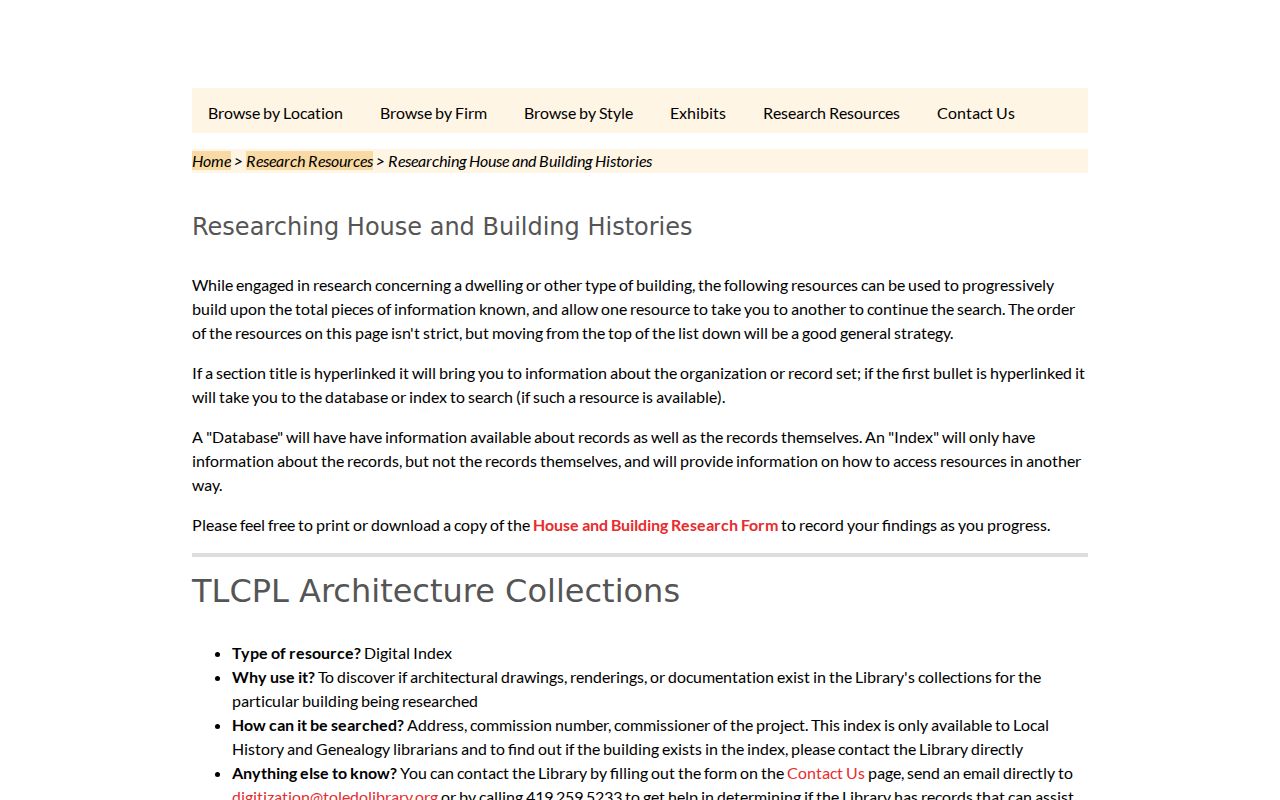
Use a Block Card or map to test the location, then return to the directory for the printed household evidence. Neither source is a substitute for the other.
For the fire-insurance layer, the Library of Congress Toledo Sanborn volume contains 93 sheets revised from 1921 through March 1951. It dates a building landscape, not a continuous list of residents.
Digital Toledo History Shelves
The TLCPL digital archive covers more than 36,000 Toledo and Northwest Ohio resources. Its collection menus reach directories, maps and atlases, newspapers, manuscripts, cemetery records, regional-history books, schools, organizational records, photographs, and several focused Toledo history collections. That breadth makes it a strong companion after a directory has supplied a name, address, period, or neighborhood.
Online access does not remove the need for the third-floor desk. The Library identifies digital collections, exhibits, newspapers, microfilm, and one-to-one assistance as part of its local-history service, so staff help remains the practical fallback for a difficult volume or a restricted item.
Several companion channels keep a city-directory result from standing alone. The Blade historical text and images reach from 1848 to the present through Library research access, while the obituary index can point to a particular notice from 1837 forward. HeritageQuest supplies released federal census coverage from 1790 through 1940, and Ancestry Library Edition is available only inside Main Library. Each resource has a different access condition and date, so it should be cited as separate support for a Toledo directory finding rather than blended into the directory entry itself.
Newly Public Toledo Plats
Historic neighborhood names can unlock a confusing old location. In August 2025, the City announced a grant to preserve nineteenth-century hand-drawn plat maps discovered in a City building. In March 2026, the City announced the public release of more than two dozen scanned maps. The work was completed with TLCPL and conservation specialists.
The release matters when a directory uses an older addition or place name. The City connects historic plats to places including Ironville, East Toledo, Englewood, Junction, Old South End, Old West End, Vistula, Lagrange, and North River. Compare the printed clue with a plat or legal description instead of assuming an old street number has the same meaning today.
Toledo Local-History Research Desk
When the online result is incomplete, use the access channels in order: the digital collection for a quick search, the named volume or microfilm at TLCPL, and a Local History appointment or telephone request for help locating related maps, obituaries, manuscript material, or building evidence. The Library's house-history assistance is support for tracing sources, not a promise that a single file will answer every question.