
Toledo Previous Residents by Record Era
Past residents leave different kinds of evidence at different times. Start with the era of the address question, then use the source that can actually place a person, property, or building in that period. The Recorder's pathway is name based, not an address directory, which makes the current parcel and its short legal description the essential bridge. Directories, census records, Block Cards, maps, obituaries, and probate records then test the result from another angle.
| Source | Years It Covers | Where Held | What It Shows |
|---|---|---|---|
| Recorded instruments | 1985-present | Lucas County Recorder Public Access | Parties, recording dates, instrument details, and legal descriptions |
| Recorder microfiche index | 1972-Jan. 2, 1985 | Lucas County Recorder office | Older name-index route before the online era |
| Recorder handwritten indexes | Before 1972 | Lucas County Recorder office | Earlier manual name-index route |
| Toledo City Directories | 1858-present | TLCPL Local History | Printed household and address evidence by volume |
| Auditor Images Block Cards | 1937-1965 | TLCPL building research | Historic address photographs and assessment context |
| Federal census through HeritageQuest | 1790-1940 | TLCPL research access | A separate household snapshot |
| Toledo Sanborn volume | 1921-Mar. 1951 | Library of Congress | Street and building-layout evidence across 93 sheets |
The date ranges overlap, but the purpose differs. A deed chronology can show transfers; a directory or census can provide a household layer; a map or Block Card can identify the physical place. Treat each as its own dated source.
Start Toledo Previous Residents With AREIS
Use the public Lucas County AREIS property search to capture the exact address, parcel number, current owner, transfer date, and short legal description. AREIS offers address, owner, parcel-number, assessor-number, advanced, map, and multi-year modes. Its property inventory includes ownership, sales data, taxes and payments, building attributes, mapping, historical transfer cards, and a permit list.
Record the exact form of the short legal description before opening the Recorder search. The Recorder warns that instruments often do not state a street address, so the legal description can prevent a false match between two similarly numbered locations. The AREIS interface also cautions that information represents the current tax year and that map boundaries are for tax purposes, not a legal survey.
Toledo Previous Residents and Recorder Eras
Lucas County's deed trail does not live in one seamless online search. The Recorder's published lien-search guidance separates the route into online general-index information from January 3, 1985 forward, microfiche from 1972 through January 2, 1985, and handwritten indexes before 1972. Plats reach back to 1815 through the Recorder's system. When an online result stops, shift to the office index instead of assuming the trail ended.
The Recorder's historical-index guidance shows the handoff between those eras.
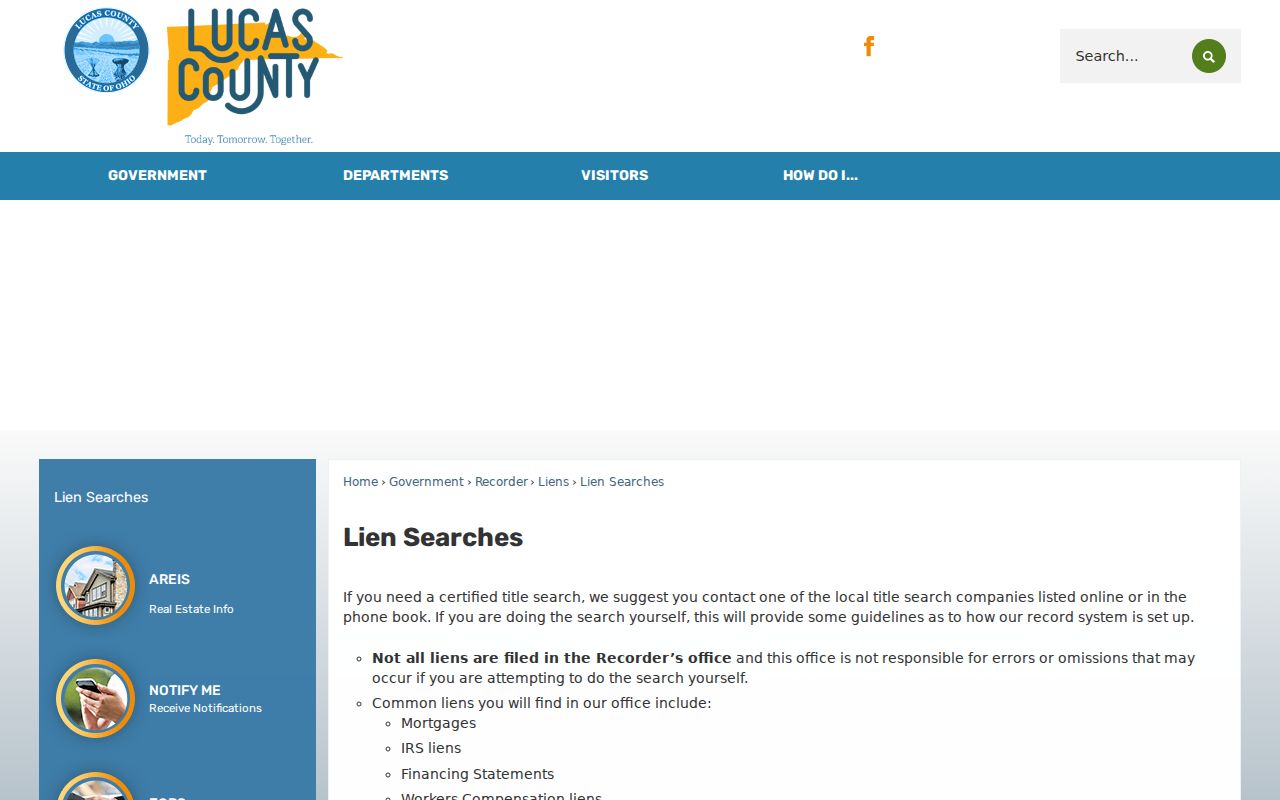
This changing access pattern is a local research quirk. It explains why an address history may need both an online name search and a visit or direct request to the Recorder.
The Recorder's AlertMe service is a free, optional name-monitoring service for documents recorded after enrollment. It does not search historical instruments for the user, and an alert by itself is not proof of fraud.
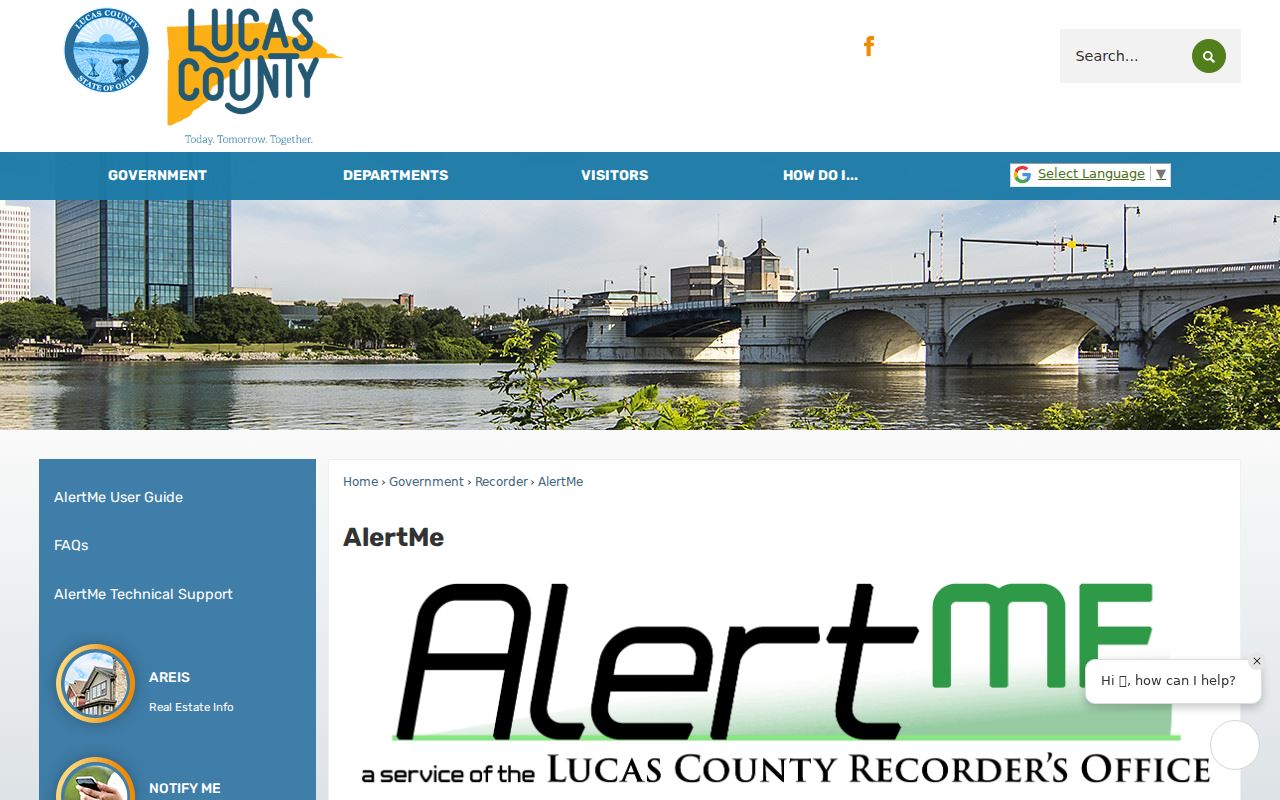
When an unexpected alert includes an instrument number, check the recorded document and compare its legal description with AREIS before drawing a conclusion about the parcel.
The Recorder history adds useful custody context: the office moved to One Government Center in 1983 and began its imaging system in 2003. The imaging date is not proof that every older instrument became digitally available then.
The Recorder office history documents the succession of county locations and records custody.
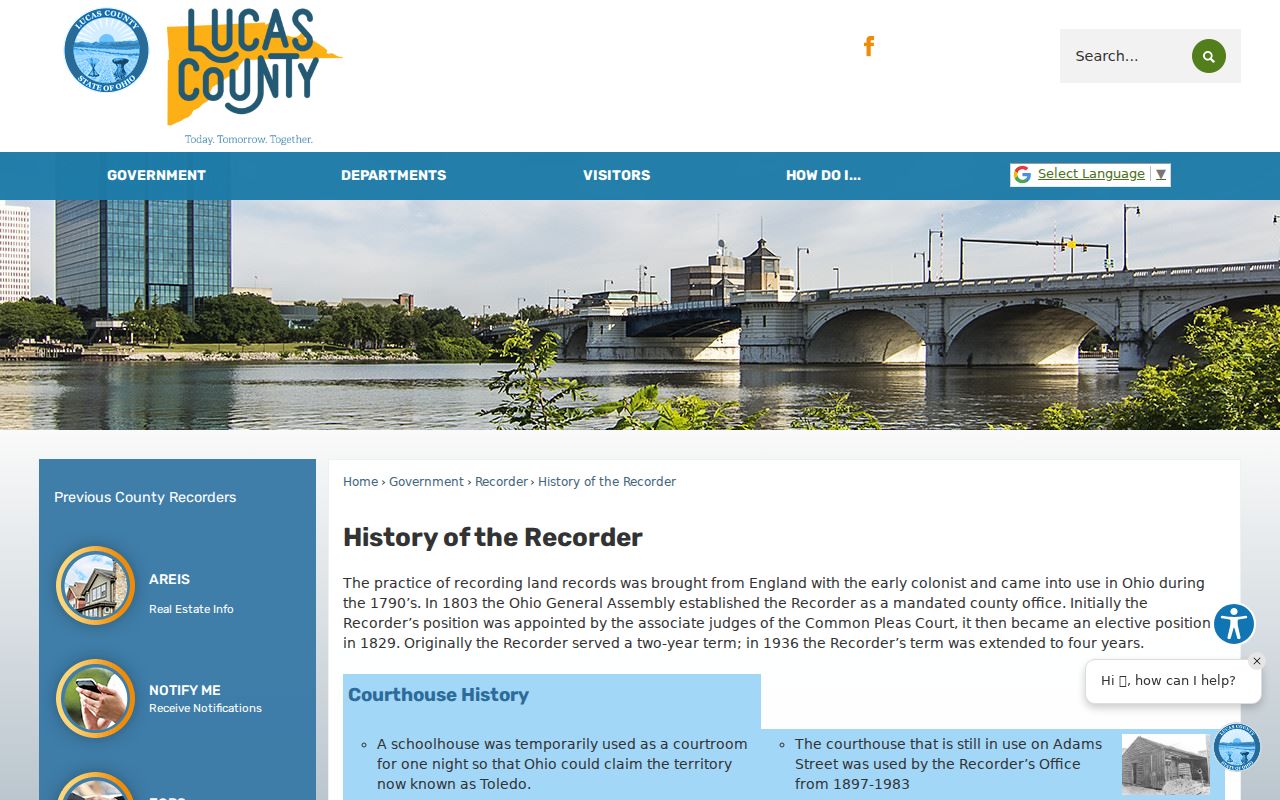
For older work, the Recorder remains the direct custodian. The County Records Center stores material for county offices but directs public requesters to the creating office rather than taking a general request itself.
Trace a Toledo Deed Chain Backward
The Recorder's Public Access search has name, date, book/page, instrument, subdivision, consideration, and legal-filter controls. After AREIS supplies the current owner and transfer date, use a bounded recording date and the owner name to locate the instrument that fits the parcel. Record the prior party, recording date, legal description, and book/page or instrument identifier before repeating the search backward.
- Capture the current AREIS parcel facts, including the short legal description and transfer date.
- Search the current owner's name in the Recorder index with a narrow recording-date range, then open or order the matching transfer instrument.
- Copy the prior party, date, legal description, and identifying number from that instrument into the proof log.
- Search that prior party as a grantee to locate the earlier acquisition, comparing the legal description at every link.
- Repeat the sequence. Move from the online index to microfiche or handwritten indexes when the period requires it.
- Grantor
- The party transferring an interest in the recorded instrument.
- Grantee
- The party receiving that interest. Searching a prior owner as grantee can reveal the earlier acquisition.
- Chain of title
- The sequence of recorded transfers linked by parties, dates, and matching legal descriptions.
- Short legal description
- The parcel wording used to match an instrument to land when a street address is missing or misleading.
- Instrument identifier
- The Recorder's book/page, instrument ID, or other reference used to return to the recorded document.
Toledo Previous Residents and Historic Plats
Historic plats can resolve a location without relying on a guessed street-number conversion. The City's nineteenth-century plats identify additions and neighborhood names including Ironville, East Toledo, Englewood, Junction, Old South End, Old West End, Vistula, Lagrange, and North River. Compare the modern parcel's legal description with a historic lot title and plat, rather than treating a similar street number as proof.
Port Lawrence and Vistula merged as Toledo in 1837, so an old record can describe a place name that a modern address search does not show. The City's historic plat collection and its March 2026 public-release announcement provide a source-backed way to compare those older descriptions. No single citywide renumbering year was verified, so one should not be assumed.
Toledo Previous Residents in Directories and Census
Property ownership and household presence are separate questions. The Toledo city directory collections provide the historical shelf and entry-reading method; use a named directory year to find printed address evidence, then compare it with a nearby released census year. Do not merge the two sources as if they represent one date. A directory is a publication cycle, while a census is an enumeration snapshot.
- Choose the deed-chain period that needs a household check, then select a nearby Toledo directory volume.
- Transcribe the printed surname, address wording, page, and volume year exactly. Before 1910, the directory may require a name-first search because its street/address index begins in 1910.
- Check another nearby directory year for a continued or changed printed address.
- Compare the resulting period with a released federal census through TLCPL research access, preserving its separate enumeration date.
- Use the Blade Obituary Index and the Lucas County Probate Court as later-life and estate leads when the person is already identified.
A person who appears in a directory may have moved, died, or simply been omitted in the next volume. The obituary pointer, an estate record, and another dated household source can help distinguish those possibilities.
Toledo Address Images for Past Residents
For the building layer, use TLCPL's Auditor Images Block Cards and building-research guidance. The Block Cards generally represent historic assessment photographs for Lucas County addresses from 1937 through 1965. They can place the structure in time, but they are not an occupant roll. The separate Library of Congress Sanborn volume has 93 Toledo sheets revised from 1921 through March 1951 and is likewise evidence about the physical setting.
These sources are most useful after the parcel and directory trail agree on the location. A building image or map supports a parcel history; it does not establish who was inside on a particular day.
Canaday Collections for Toledo Histories
Once a parcel and household sequence is established, the University of Toledo's Ward M. Canaday Center can supply archival context for Toledo and Northwest Ohio. The Center is in Carlson Library, fifth floor, and preserves primary-source collections about civic leaders, labor organizations, social-service agencies, and local corporations. Online finding aids, ArchivesSpace, university archives, rare books, and selected digital materials can be searched before a visit.
The Canaday Center manuscript collections show the scope of that archive.
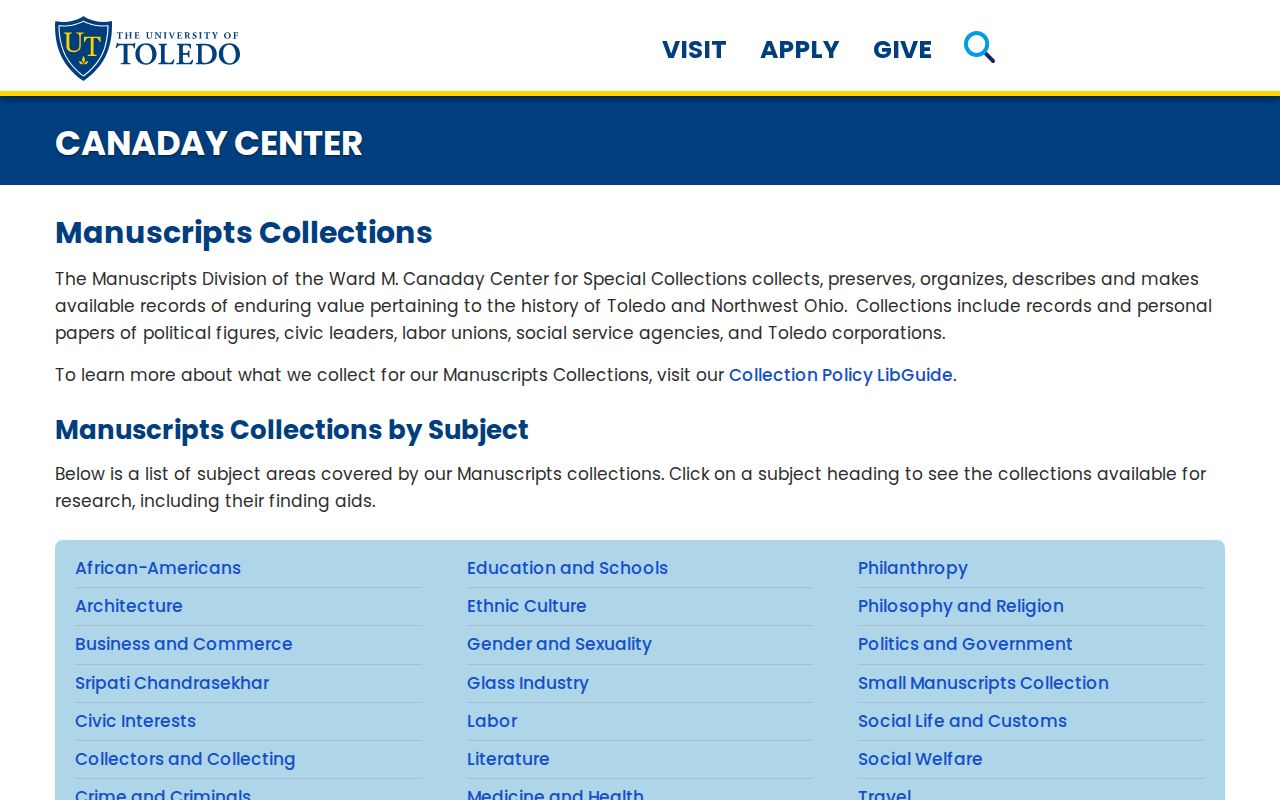
These collections can add neighborhood or civic context to a completed record trail. They are not a substitute for the Recorder, directory, or census source that supplies the underlying address evidence.
The Canaday Center collection discovery tools lead to finding aids and collection descriptions.
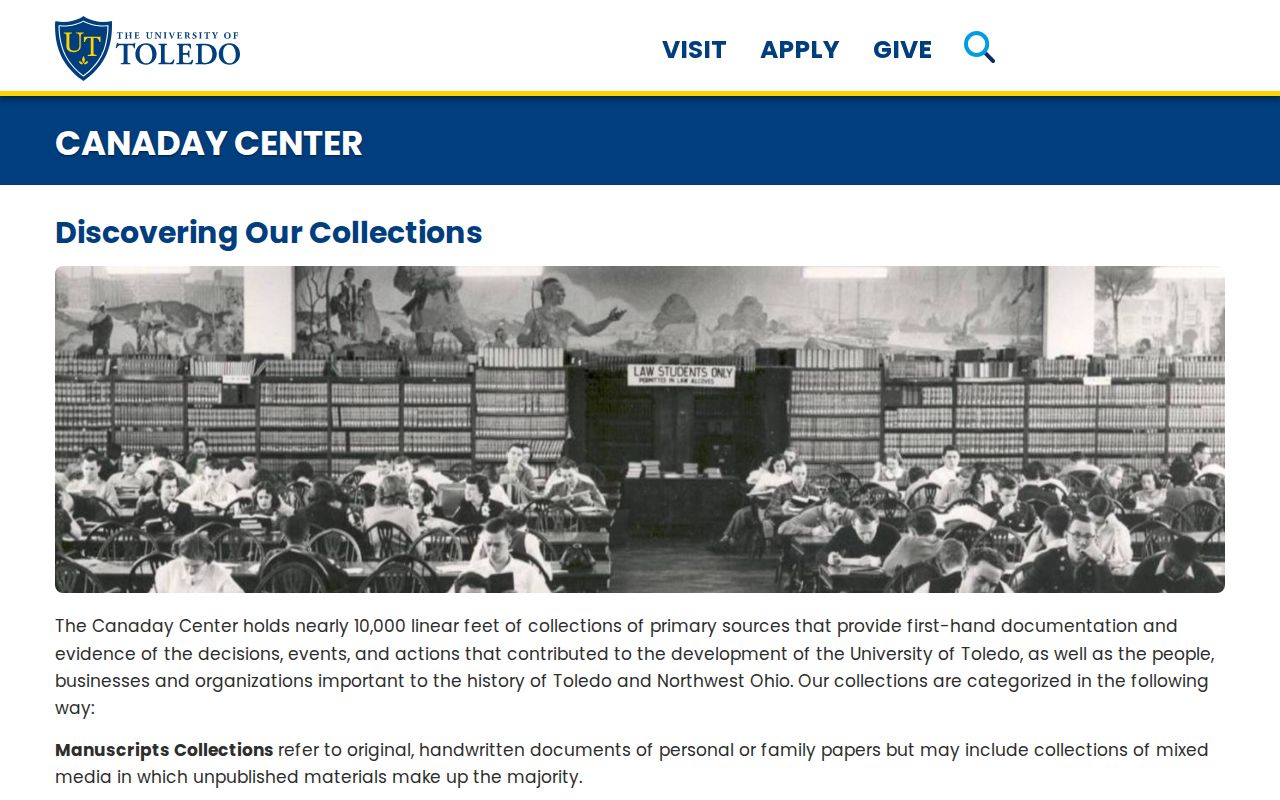
Remote assistance is limited rather than full archival research service, so a specific collection and focused question make the best use of its access channel.
Use Toledo Address History Lawfully
Use historical address records for family research, an estate question, a property timeline, or local history. Keep a clear difference between what a dated source proves and what it merely suggests. A recorded owner or a name in a directory does not identify every person who lived at an address, and historic records can contain spelling changes, omissions, and older place descriptions.