
Start a Toledo Residents Search
Begin with the record tied to the question. A current owner or parcel question belongs with the Auditor’s property system. A transfer or lien question belongs with the Recorder. A name that needs a court, voter, vital, estate, or historical check has a different custodian. That division matters because Toledo has no single public household roll. The best results are date-stamped and compared with another record instead of treated as a final answer.
Use a street address to reach a parcel, a legal description to match land documents, and a full name plus Lucas County for voter verification. For an older household, date the evidence: an old directory, released census, obituary pointer, or map each captures a different moment. The official route may not name every resident at an address, and a listed owner is not automatically an occupant.
- Search the Lucas County Auditor AREIS record by address, owner, parcel number, or map when the starting point is a property.
- Keep the parcel number, transfer clue, and short legal description, then match that description in the Recorder’s Public Access index.
- For a known person’s Ohio registration, use My Voter Information with first name, last name, and Lucas County.
- Use court, probate, or vital-record channels only for the question each one can answer, then verify a possible match with a second source.
- When the online trail ends, contact the creating office, use its public counter or request path, and turn to the library or archives for historical material.
Toledo Records Offices for Residents
Three county offices form the core Toledo residents directory trail. The Auditor connects an address to a parcel and property record. The Recorder indexes parties and legal descriptions on land instruments. The Board of Elections provides a name-and-county registration check, subject to Ohio’s exclusions. Courts, the health department, Probate Court, City departments, and the library serve narrower questions. The full address sequence belongs on the Toledo Streets page.
Lucas County Recorder
One Government Center, Suite 700
Toledo, OH 43604
419-213-4400
Lucas County Auditor
One Government Center, Suite 600
Toledo, OH 43604
419-213-4406
Lucas County Board of Elections
3737 W. Sylvania Ave., Suite 121
Toledo, OH 43623
419-213-4001
These offices work in sequence, not as interchangeable directories. The Auditor’s record is built around the parcel and current tax-year property information; it is updated through a process that can leave the newest change behind during maintenance. The Recorder’s index is built around named parties, instruments, dates, and legal descriptions. The elections office handles registration questions, while a court or health-office record must be requested from its own custodian. Keeping the source type with the result makes it clear what a Toledo record actually establishes.
County offices are clustered at One Government Center, but the office that created a file remains the right fallback. The County Records Center stores more than 47,000 boxes and 26,000 microfilm rolls for county offices, yet it directs members of the public to the creating office for a request. A marriage-license or estate question goes to Probate Court, a General Division case question goes to the Clerk, and an older directory or map question belongs with Local History.
Toledo Parcel Records in AREIS
AREIS is the property bridge for a Toledo address. Its public search modes include address, owner, parcel number, assessor number, county map, advanced, and multi-year searching. The address mode separates street number, direction, street name, suffix, and unit. Advanced search adds useful local filters such as municipality, ZIP code, street name, owner occupied, sale date, legal description, tax district, and year built. A selected record can lead to ownership, sales, taxes and payments, structure information, transfer cards, permits, and parcel mapping.
The AREIS property-search interface is the source shown below. The search form lets a researcher turn a usable address into the identifiers needed for a later deed search.
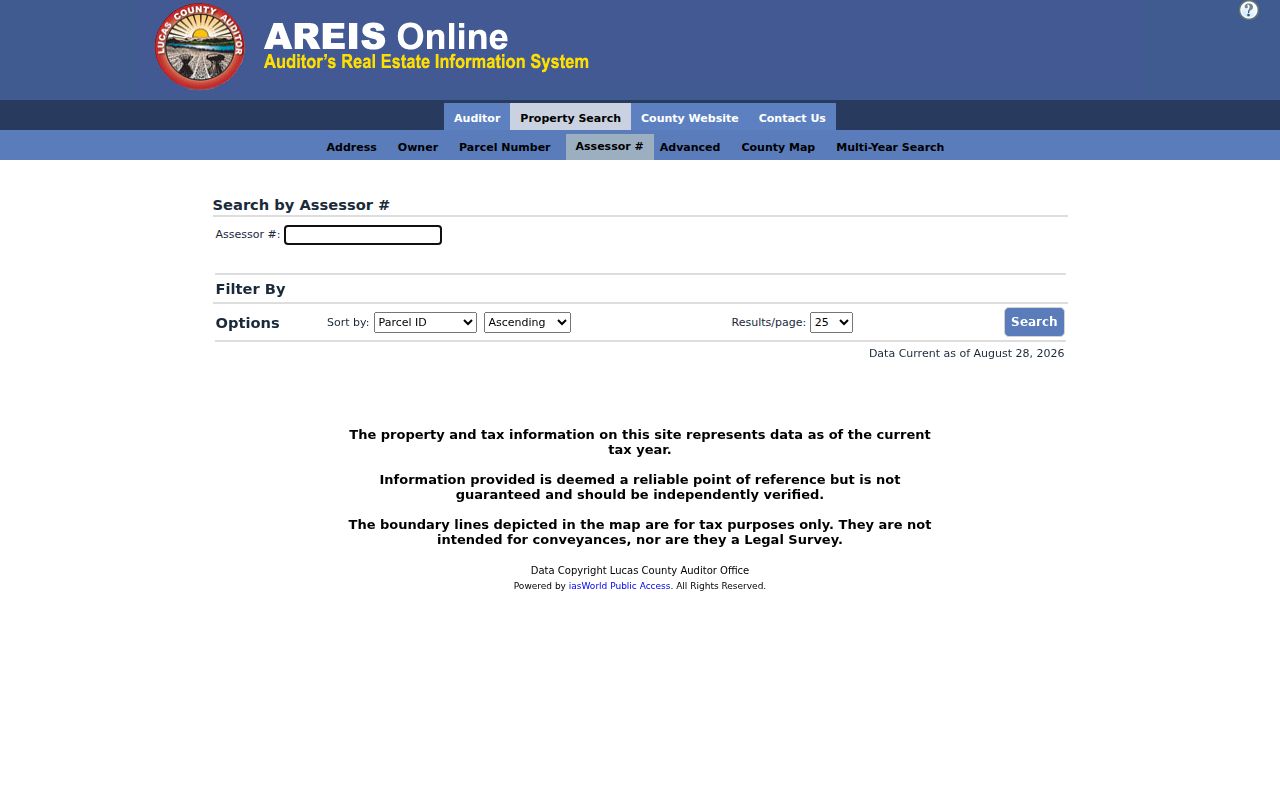
The address, owner, map, and advanced modes are distinct paths. An AREIS parcel is property and tax evidence, not a complete household record.
| AREIS search route | Useful Toledo input | What to retain |
|---|---|---|
| Address | Number, direction, street, suffix, unit | Parcel number and short legal description |
| Owner | Owner name | Property association and transfer clue |
| Advanced | Municipality, ZIP, street name, legal description | A focused set of parcel leads |
| County Map | Selected parcel | Map relationship to streets and nearby parcels |
Toledo Deed Index Eras
The Recorder’s index adds dates and named parties to a parcel trail, but it is not a street-address directory. Recorded instruments often require the short legal description from AREIS for a sound match. Public Access provides documents online from 1985 and plats back to 1815. For an older land trail, the Recorder identifies microfiche from 1972 through January 2, 1985 and handwritten indexes before 1972. That physical sequence is the meaningful fallback, rather than an assumption that a missing web result proves no transaction occurred.
Lucas County Recorder Public Access displays name, role, other party, instrument type, date, instrument ID, short legal, book/page, consideration, and notes among its result fields.
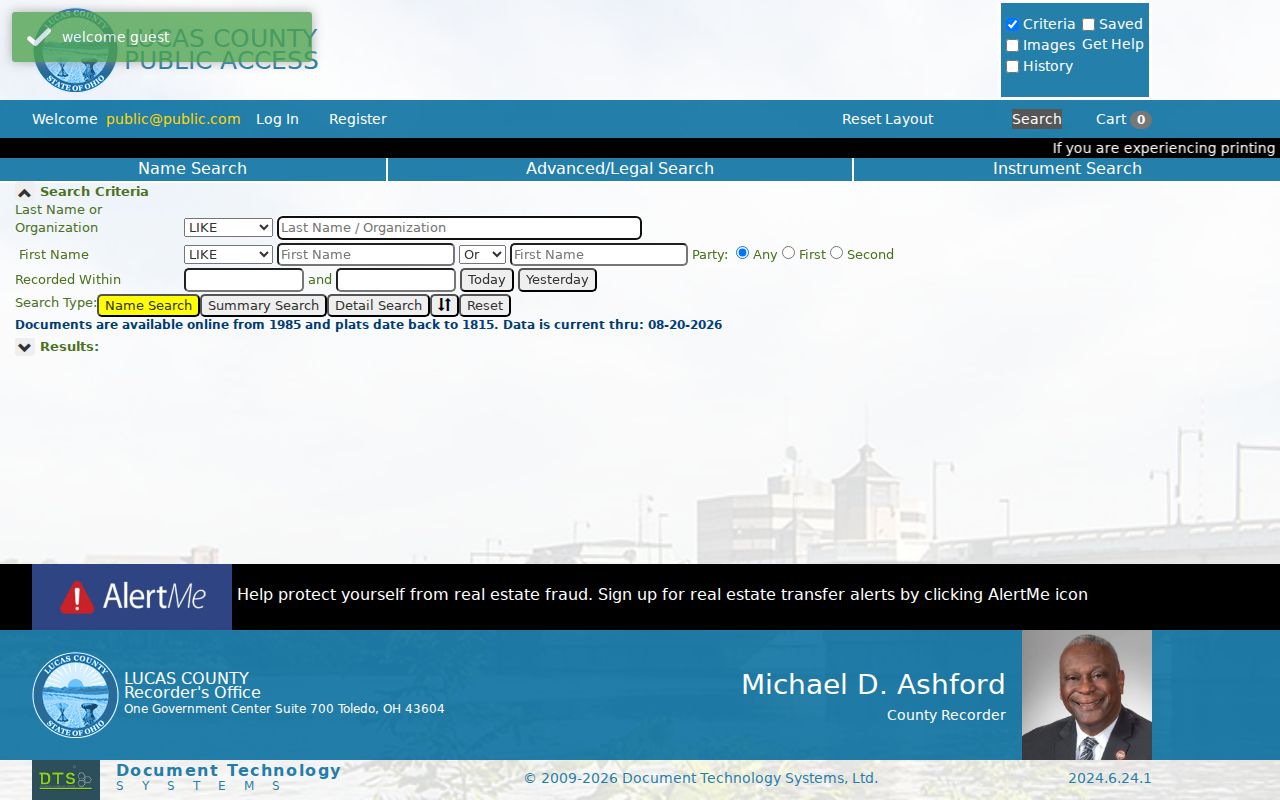
Search the current owner with a sensible date range, compare the short legal, and preserve the instrument identifier. Then use the earlier party and an earlier date window when a historical trail is needed.
- Parcel
- The Auditor’s property identifier that connects an address to tax and map records.
- Short legal
- A condensed legal description used to compare a parcel with a recorded instrument.
- Index
- A finding tool that points to a record; it is not always the record image itself.
- Criss-cross directory
- An address-arranged directory, when a collection catalog confirms that a volume includes one.
Toledo Current Resident Sources
Current directory-like sources have different coverage. AREIS can associate an owner with a parcel. The Recorder names parties to land instruments. The state voter tool verifies a matching registration and precinct when the required name and county are supplied. Court and license systems answer separate, limited questions. A one-person check needs source-by-source verification, as explained in the Toledo resident lookup.
| Toledo source | What it may confirm | Custodian | Access path |
|---|---|---|---|
| AREIS parcel record | Owner and property-tax association | Lucas County Auditor | Free public portal |
| Recorder instrument index | Parties, dates, legal descriptions | Lucas County Recorder | Online from 1985; older office indexes |
| My Voter Information | Registration and precinct for a match | Ohio Secretary of State | First name, last name, county |
| Municipal case search | Named case and case-number lead | Toledo Municipal Court | Public search and certified-journal fallback |
| Local history collections | Past directory, obituary, map, and census leads | TLCPL | Online plus desk and appointment access |
Official records are stronger for verification because each has a named custodian and a date context. Commercial people-finding services may mix sources of different ages, conflate similar names, or omit the record limits that an official portal explains.
Some Toledo questions need a more specialized source. Probate Court is the county contact for marriage-license and estate questions. The Toledo-Lucas County Health Department issues local vital certificates through its published phone, counter, mail, and online channels. TLCPL’s Blade obituary index can provide a newspaper lead from 1837 forward, while a released federal census is a separate dated household snapshot. These sources add context only when their time period and stated scope match the question.
Toledo Court Name Search Fields
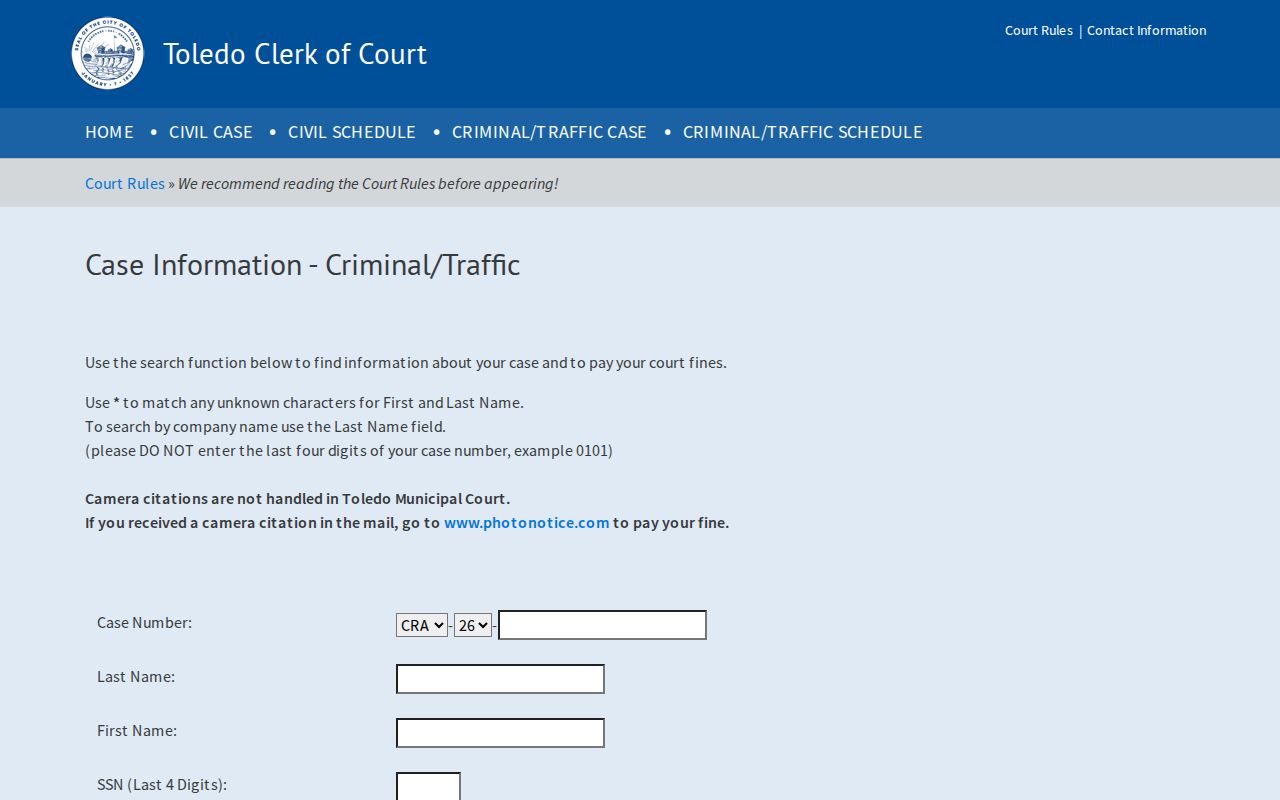
Toledo Municipal Court keeps separate civil and criminal/traffic search forms. The criminal/traffic search accepts a case number, last and first name, last four SSN digits, year of birth, attorney name, and attorney number. It allows an asterisk for an unknown character in a first or last name, and its instructions say not to enter the final four digits of a case number. A year-of-birth entry returns dates within one year of the number entered. These fields help narrow a name search, but the Court cautions that online data needs verification.
The Toledo Municipal Court criminal and traffic search is illustrated here. A certified journal is available by phone at 419-936-3650, and the court counter is at 555 N. Erie Street.
For Common Pleas matters, the County’s Online Dockets entry directs General Division searches to re:SearchOH and Justice Case Access, both account-based as of January 2026.
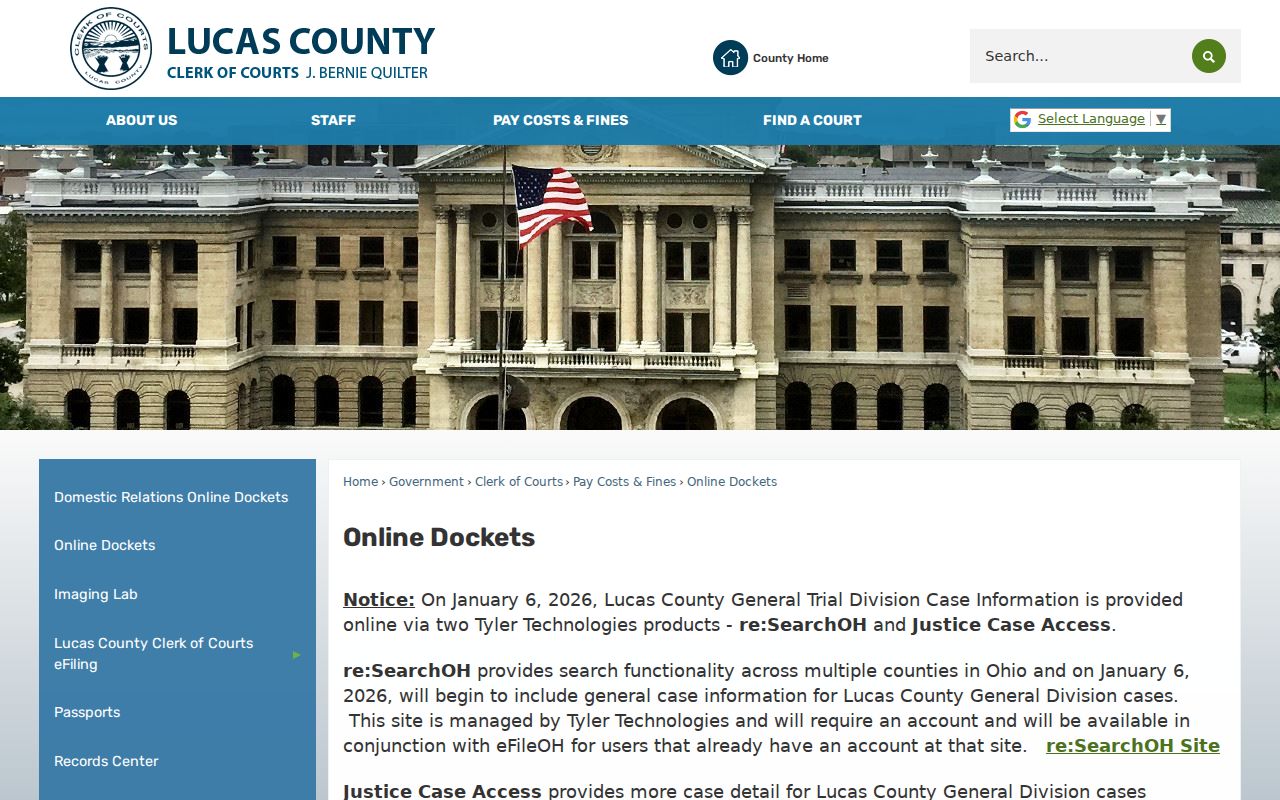
Those systems are court-record routes, not proof of a current address or household.
Toledo Voter Checks by Name
Ohio’s My Voter Information is a person-specific verification tool. The initial form requires first name, last name, and county; select Lucas for a Toledo registration. The state recommends trying a known name variation, former surname, or prior Ohio county if no match appears. A later street-name selector may narrow a result, but the official form is not a way to browse a block or generate a street roster.
Ohio law makes registration material public subject to important exclusions, including protected information and Safe at Home records. A returned record should be treated as a limited registration/precinct check. Ballot choices are not available from the official lookup. For a current request policy, permitted uses, or a possible correction, contact the Lucas County Board of Elections at 419-213-4001.
Toledo Vital and Death Paths
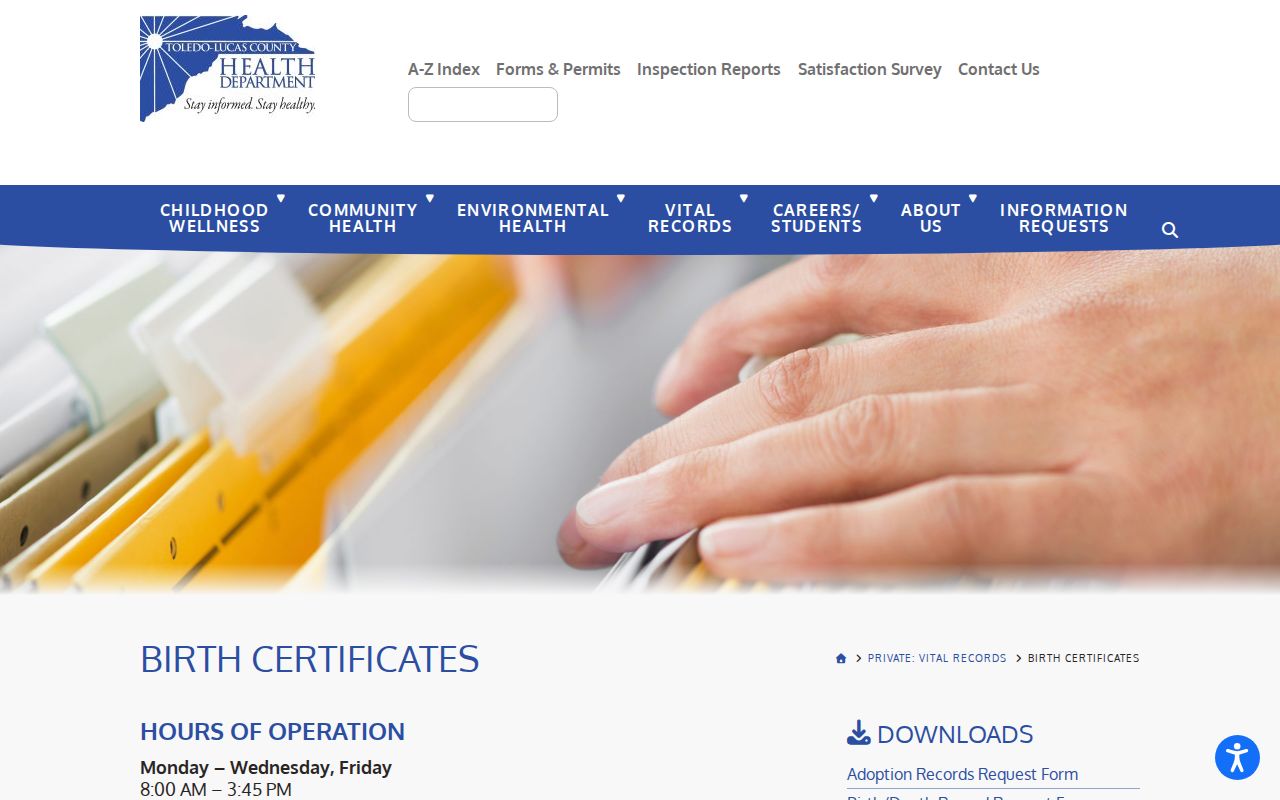
Vital records and archive indexes serve different dates and purposes. The Toledo-Lucas County Health Department issues certified copies for Ohio births after 1908 and Lucas County deaths. Its listed channels are phone, in-person, mail, and online fulfillment. The local price stated for a certified birth or death copy is $25, while card processing adds a fee. The office is at 635 N. Erie Street, and its page says counter service generally takes about 15 minutes for most certificates.
The Health Department’s vital-record request page shows the local certificate route. A certified copy remains an official record, while a historical index is only a lead for further research.
The Ohio History Connection death index covers Ohio Department of Health death certificates for 1913-1944 and 1954-1970, plus specified related periods. It does not itself provide all images, and the broader archive collection has its own ordering process.
Toledo Public-Record Fallbacks
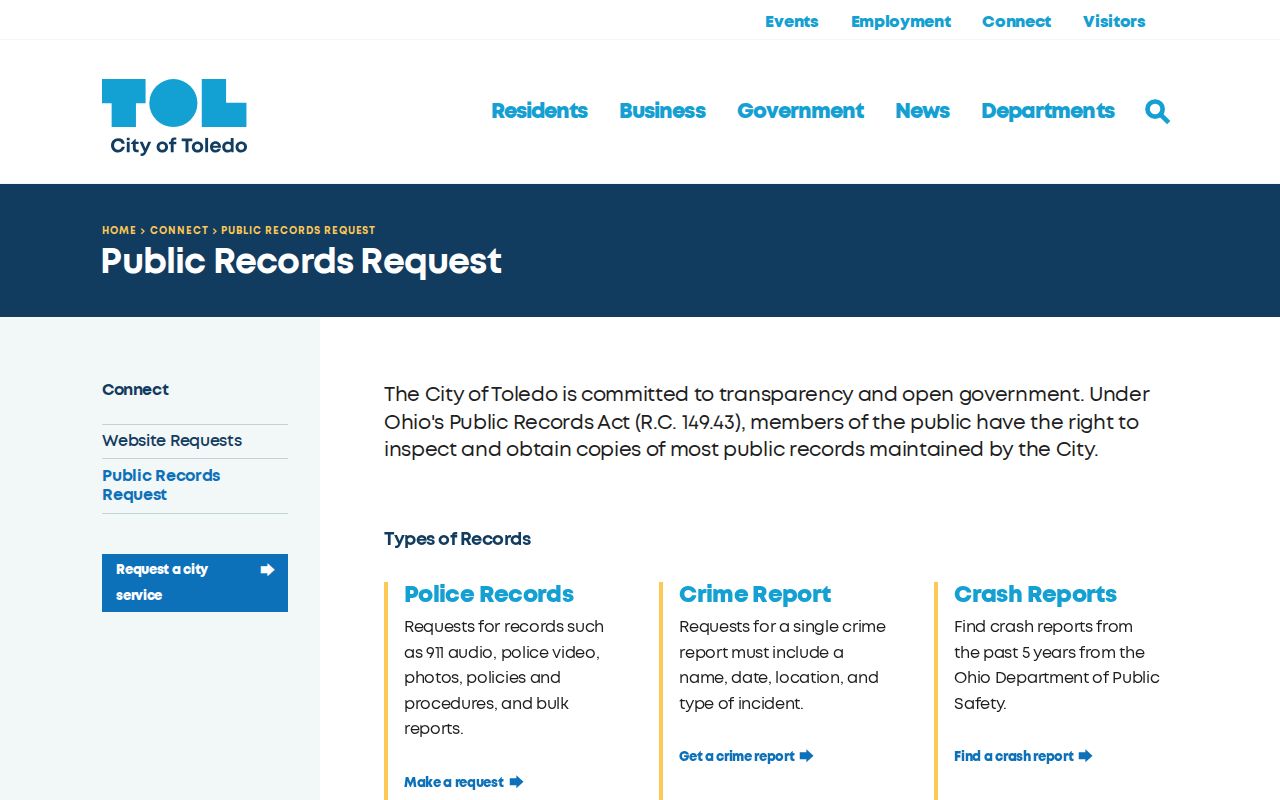
Ohio’s Public Records Act, Ohio Revised Code §149.43, allows inspection subject to exemptions. The Ohio Attorney General explains that inspection should be prompt and copies provided within a reasonable time; the law does not set one fixed response-day count. Lucas County’s Clerk policy says a requester need not use a special phrase, give a reason, or submit a request in writing. If an office denies a record, it must identify the legal authority, and a written request receives a written explanation.
The City of Toledo public-records request page directs property, fire, police, and other categories to the appropriate channel. The County Records Center stores material but does not accept public requests directly; ask the office that created the record.
Note: A missing, redacted, or substitute address must be respected, especially where Ohio Safe at Home protections apply.
Toledo Historical Resident Directories
Toledo-Lucas County Public Library holds Toledo City Directories from 1858 to the present, with 1858-1935 on microfilm and 1936-present in books. The library’s building-research guidance says the city directory gains a street/address index in 1910. Earlier entries may need a surname, business, map, plat, or cross-street approach instead. The full historical shelf, entry-reading method, and household-tracing sequence appear on the Toledo City Directory page.
A directory year can place a printed address, occupation, boarding notation, or affiliation only where the volume actually shows it. It should not be converted into an exact move date or a claim about every household member. Pair it with a released census, obituary index, map, or deed trail when the question reaches beyond the printed entry.
Toledo Library Records Desk
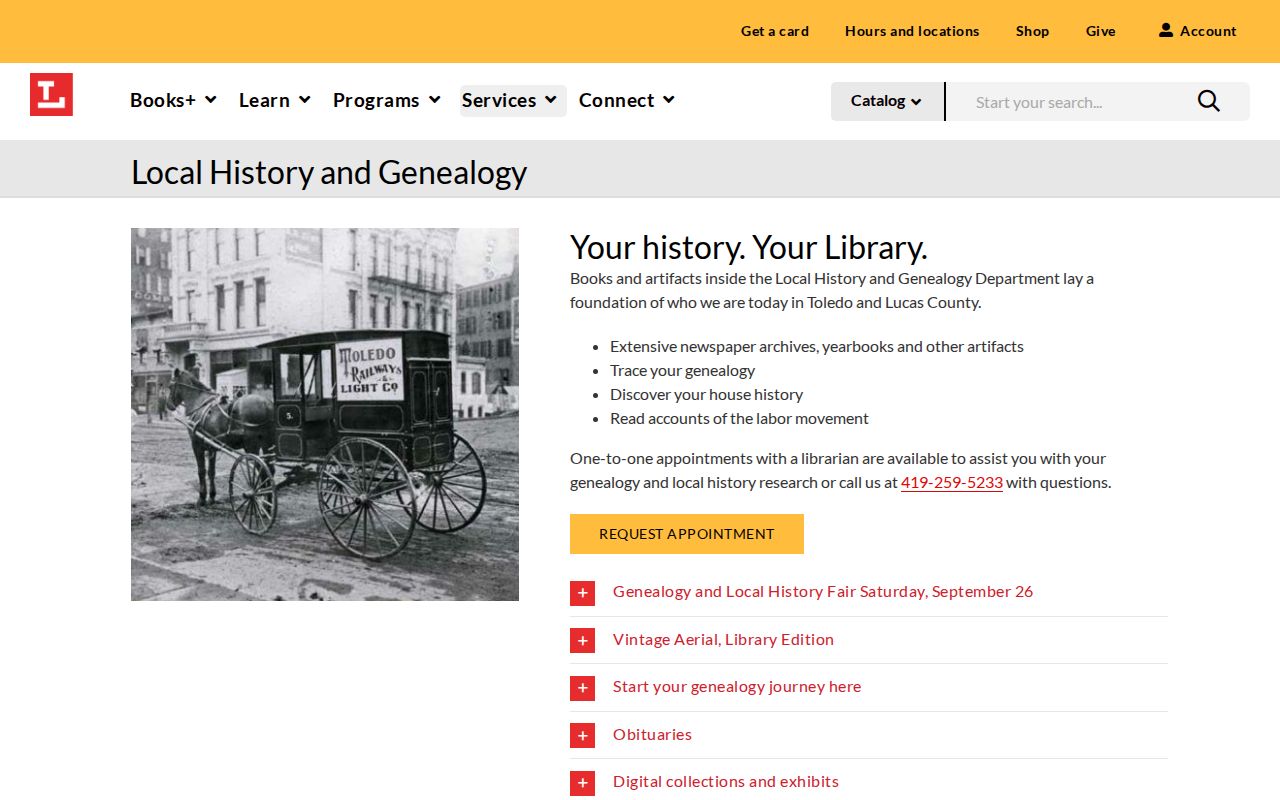
The Main Library Local History and Genealogy Department is a practical Toledo research fallback when a result is not digitized or needs context. It is on the third floor of Main Library, 325 Michigan Street, and offers local government microfilm, city directories, newspapers, yearbooks, manuscript inventories, obituary help, maps, and house-history assistance. One-to-one appointments are available through the Local History desk at 419-259-5233.
TLCPL Local History is shown below. Its digital collections cover more than 36,000 Toledo and Northwest Ohio resources, but staff and physical collections remain the route for restricted, undigitized, or difficult material.
The Blade obituary index reaches from 1837 to the present and can lead to a scan or copy request. It is a date-specific newspaper finding tool, not a current resident roll.
Local History also supplies a practical human-access channel. A librarian can help distinguish an undigitized volume from an online item, locate local-government microfilm, or explain whether an address project needs a map, city directory, Block Card, obituary pointer, or manuscript finding aid. The department’s digital archive is broad, but its in-person desk and telephone appointments matter when a catalog record is ambiguous or a source needs careful interpretation. A research note should preserve the collection name, volume or item date, and page or image reference beside every historical finding.
Toledo Plat Maps Now Online
Toledo’s newly public nineteenth-century plat project provides a local records story that helps explain older land descriptions. The City received a 2025 grant to preserve roughly 660 pages of hand-drawn plats, then reported in March 2026 that more than two dozen scanned maps were available. The maps connect historic additions and neighborhood names, including Port Lawrence, Vistula, Ironville, East Toledo, Englewood, Junction, Old South End, Old West End, Lagrange, and North River.
The City’s historic Toledo plat-map collection can help compare an old lot or addition name against a modern legal description. Port Lawrence and Vistula merged as Toledo in 1837, so older sources can legitimately use place names that differ from today’s map. A plat is geographic context, not a resident list, and a modern parcel still needs independent record verification.